Start Your Project Today
Share your details and our team will follow up with specifications, options, and project guidance.

Why material choice defines your project's performance — a specification-focused guide for architects and general contractors.
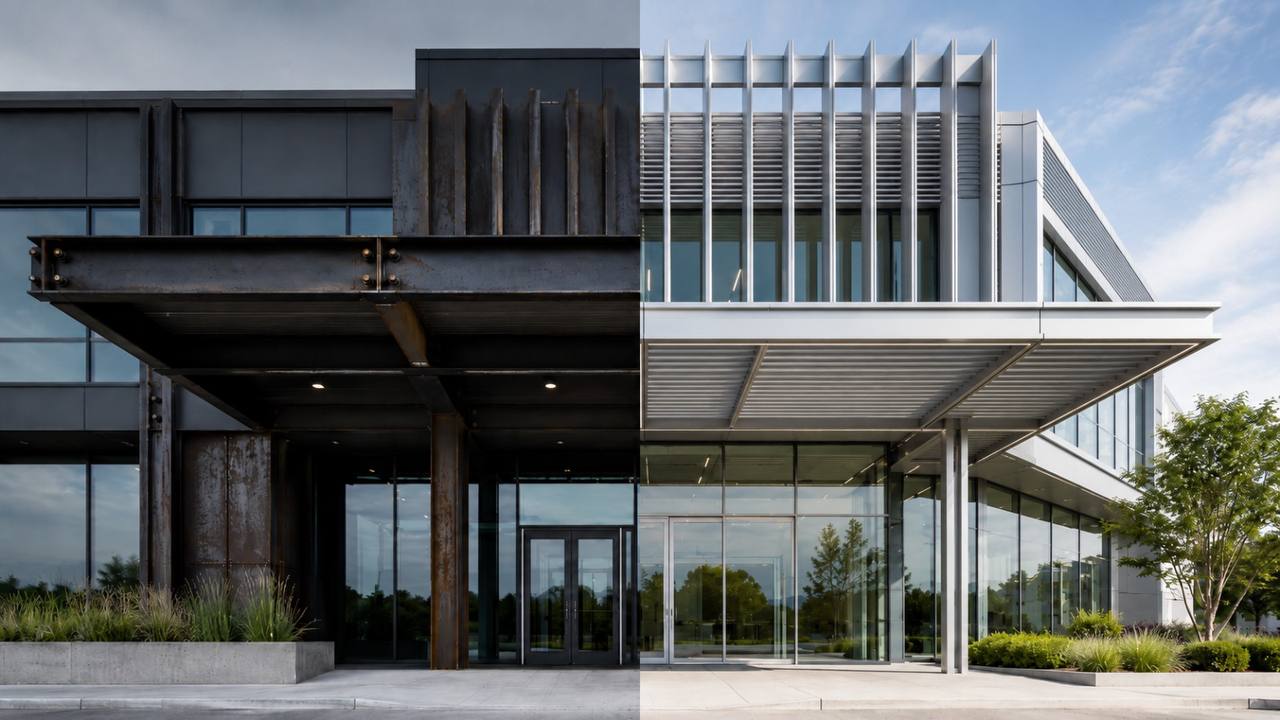


When you're specifying exterior architectural elements — sunshades, canopies, facade fins, or custom cladding — the material choice you make at the schematic design stage ripples through every downstream decision: structural connections, finish longevity, fabrication lead times, and long-term maintenance obligations. Aluminum and steel are both workhorses of commercial construction, but they perform very differently when exposed to the demands of an architectural envelope.
This article breaks down the key technical differences between aluminum and steel extrusion, helping you make more informed specification decisions and better communicate trade-offs to your clients and project teams.
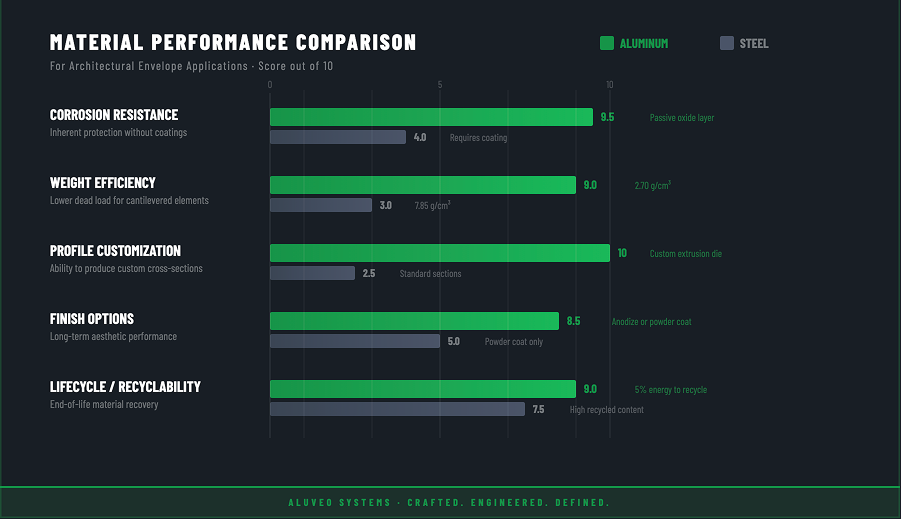
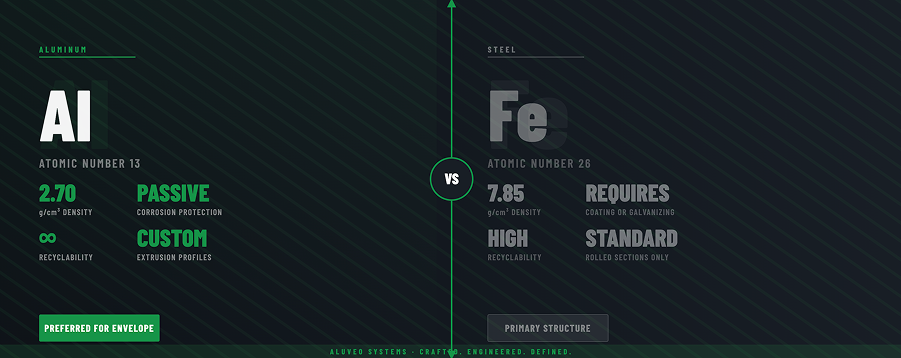
Steel is strong — but it oxidizes. Unless protected with coatings, galvanizing, or alloying (as with stainless steel), carbon steel in exterior applications will begin to rust. That oxidation isn't just cosmetic; it undermines structural integrity over time and generates ongoing maintenance costs that are rarely captured in a first-cost analysis.
Aluminum behaves fundamentally differently. When exposed to air, aluminum spontaneously forms a thin, stable layer of aluminum oxide on its surface. This oxide layer is tightly bonded, self-repairing, and acts as a barrier against further corrosion — without any added coating. In coastal environments, high-humidity climates, or projects where maintenance access is difficult (think high-rise facades or covered walkways), this passive corrosion resistance is a significant specification advantage.
"Aluminum's natural oxide layer means the material is essentially protecting itself. That changes the lifecycle cost conversation entirely, especially on projects where repainting or recoating steel would require scaffolding."
For architects specifying sunshades, canopies, or louver systems on the building envelope, aluminum's inherent corrosion resistance typically translates to lower total cost of ownership — even when first material costs are comparable to coated steel alternatives.
Steel is heavier than aluminum — roughly three times denser by volume. For structural members carrying significant loads, that density can be an asset. But for architectural elements designed primarily to manage solar gain, provide weather protection, or add visual articulation to a facade, excess weight creates problems:
Aluminum's strength-to-weight ratio allows fabricators and engineers to design architectural members that are structurally sufficient without being structurally overbuilt. A well-designed aluminum extrusion profile can achieve the required moment of inertia for a sunshade blade or canopy fascia with substantially less material mass than an equivalent steel section.
For multi-story projects where sunshades or fins repeat across dozens or hundreds of openings, the cumulative weight difference between aluminum and steel can meaningfully affect structural engineering assumptions and connection design.
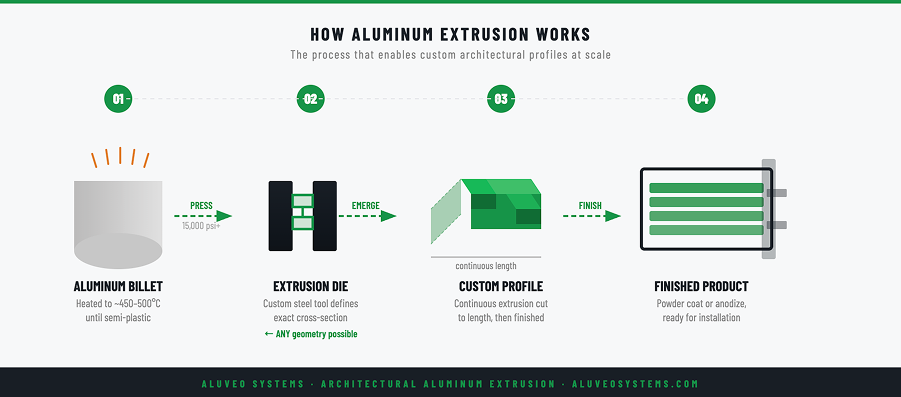
This is where aluminum's fabrication advantages become most apparent for architectural applications. Aluminum extrusion is a manufacturing process in which heated aluminum billet is forced through a shaped die, producing continuous profiles of virtually any cross-sectional geometry. The economics of aluminum extrusion tooling are accessible enough that custom die development is feasible even for mid-size projects.
What does that mean in practice? An architect can specify a sunshade blade profile with a precise aerodynamic cross-section, integrated water drainage channels, and a clip-based attachment interface — and have that exact profile manufactured to tight dimensional tolerances at competitive cost. Steel doesn't offer this flexibility. Steel shapes are limited to standard rolled sections (angles, channels, tubes, wide flanges) or expensive custom fabrication through bending, welding, and machining.
Custom aluminum extrusion profiles allow architectural intent to be built directly into the material — not approximated by assembling standard steel shapes.
For louver blades, fin profiles, and canopy fascia members where the geometry itself is part of the design expression, aluminum extrusion is the enabling technology. It's why the vast majority of architectural sunshade and louver systems on the market today are aluminum-based.
Aluminum conducts heat significantly more readily than steel. In the context of window framing and curtain wall systems, this thermal conductivity is a liability — aluminum frames create thermal bridges that increase heat transfer through the building envelope, typically requiring thermal break technology to meet energy code requirements.
In the context of exterior shading elements, however, the thermal conductivity calculus changes. Aluminum sunshade blades that absorb solar radiation will also dissipate that heat relatively quickly through convection and re-radiation. They don't retain heat in the way that a dark-colored mass wall or steel element might. For shading products specifically, this is a minor technical consideration rather than a primary specification driver — but it's worth understanding for projects in extreme climates where surface temperatures of exterior elements are a design concern.
Steel exterior elements are almost universally painted or powder coated to provide corrosion protection. These finish systems perform well when properly applied and maintained, but they add cost, require periodic inspection, and eventually need reapplication.
Aluminum can be powder coated as well — and for architectural applications requiring a wide range of colors and finishes, powder coat is often the specified approach. But aluminum also supports anodizing, an electrochemical process that converts the surface layer of aluminum into a dense, highly wear-resistant aluminum oxide finish. Anodized finishes are:
For high-visibility architectural elements where finish longevity and appearance quality over decades matter, the anodize option represents a meaningful differentiation versus steel alternatives.
Sustainability is an increasingly explicit specification requirement, particularly on projects pursuing LEED certification or responding to owner sustainability mandates. Here, aluminum carries a nuanced story.
Primary aluminum production is energy-intensive — the smelting process has a significant carbon footprint. However, aluminum is infinitely recyclable without degradation, and recycled aluminum requires only about 5% of the energy needed to produce primary aluminum. A large and growing share of architectural aluminum extrusion is produced from recycled content, and manufacturers increasingly provide Environmental Product Declarations (EPDs) with verified recycled content percentages.
Steel is also highly recyclable, and structural steel in particular has a long history of high recycled content. For projects where embodied carbon is a tracked metric, both materials require careful specification of recycled content and sourcing to achieve low-carbon outcomes. Neither is automatically "green" — but both can be responsibly specified.